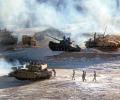
'India cannot allow Beijing's policy of stabilising and destabilising the border at will to perpetuate its own ends.' A riveting excerpt from Manish Tiwari's 10 Flashpoints; 20 Years National Security Situations That Impacted India.
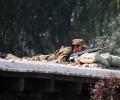
WWhat Pakistan faces in the Tehrik-e-Taliban Pakistan is virulent insurgency and terrorism, fuelled by its association with Al Qaeda

Did Vinod Sehgal die in Tsangdgar or was he taken PoW to Tibet or China? Why has the IAF kept so quiet for all these years, asks Claude Arpi.
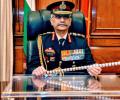
Nepal raised objection to India's newly-inaugurated road linking Lipulekh Pass with Dharchula in Uttarakhand.
.jpg)
With its Mitsubishi JV beginning operations this quarter, analysts expect meaningful revenue addition
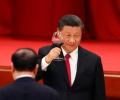
After the Ladakh fiasco where Xi Jinping did not expect the Indian Army to resist his land-grabbing tactics, he has to save face before his colleagues in the Communist party.' To bring the threat of a mega-dam to the northern Indian border is a clever move, observes Claude Arpi.

Tata Communications has invested around Rs 6.5 billion in developing its IoT business, which is being managed by some 75 executives over the past three years.

'I believe Modi mentioned Balochistan only to embarrass Pakistan and also divert attention toward the situation in Kashmir.' 'I think from now on, India intends to raise Balochistan whenever Pakistan brings up Kashmir or upsets them on the issue of terrorism.' 'Balochistan is the least developed of Pakistan's four provinces. It is the least educated and least economically developed. People are agitated that a region so rich in mineral resources and a sea-port is still so poor.' Baloch political analyst Malik Siraj Akbar on why the province wants freedom from Pakistan.

The bodies of two terrorists had been recovered on Sunday.

On August 4, the UFO was sighted by Army troops in Lagan Khel area in Demchok in Ladakh area in the evening and a report has been sent to the Army headquarters by the local formation, sources said in New Delhi.

India must break out of this strategic triangulation between China and Pakistan. We need to settle our issues with one of the two, notes Shekhar Gupta.
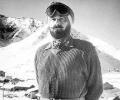
Lieutenant General Harbakhsh Singh, GOC, Western Command, disobeyed the then army chief and took on a superior Pakistani armoured column. The Indian Centurion tanks outgunned the more modern Pakistani Patton tanks in the battle at Khem Karan, that proved the turning point of the 1965 War. Brigadier Gurmeet Kanwal (retd) salutes the Soldiers' General.

'Our defence services are in a position to checkmate any Chinese adventurism.'
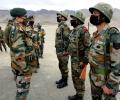
'India is not the India of 1962. We are not carrying that baggage of history anymore.'

India's military prowess and multi-hued images of the country's rich cultural diversity and achievements in various fields were on display at the majestic Rajpath on Tuesday during 67th Republic Day parade which was graced by French President Francois Hollande as the chief guest.

The brutal Tehrik-e-Taliban Pakistan assault has claimed 141 lives, including 132 school children, six terrorists and three armymen.
The experts said adequate care must be taken before implementing what is being touted as a "game-changer".
Why does the army remain embroiled in counter-insurgency, denying itself a peace dividend even after expending blood and treasure in imposing calm?

Apprehending attack by Pakistan's Border Action Team on forward posts and patrol parties in the run up to Republic Day, Army has sounded an alert along the boundary with Pakistan in Jammu and Kashmir.
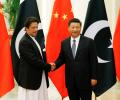
Gilgit Baltistan's large frontage with Kashmir and Ladakh across Kargil and the Siachen Glacier gives Pakistan and China the perceived scope for conduct of collusive operations against India and wrest control of the major course of the Indus and Shyok, observes Lieutenant General Syed Ata Hasnain (retd).

Pakistani troops continued breaching the ceasefire along the LoC for the fourth successive day on Saturday by resorting to unprovoked firing and shelling, while two persons have been injured and several houses damaged in Jammu region overnight due to the violation.
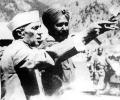
Let us hope that what happened in 1962 will never happened again, prays Claude Arpi
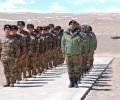
'The Indian government wakes up after the fact when it can do nothing, or rather lacks the will to prosecute military actions to reverse these adverse PLA-driven developments.'

General Zhao Zongqi is well known in India for having commanded the Chinese troops during the Dokalam episode. Zhao knows every inch and corner of the Indian border, at least the Eastern and Central sectors, including the Naku La area which witnessed fist-fights between Indian and Chinese troops in April/May. Claude Arpi introduces us to the PLA generals masterminding the Chinese aggression in Ladakh.

Ajit Mishra, Vice President, Research, Religare Broking, answers readers' queries on a weekly basis.

'The military aim in a future conflict, if it can't be avoided, should be to cause maximum damage to the adversary's war waging capability and capture limited amount of territory as a bargaining counter,' says Brigadier Gurmeet Kanwal (retd).

It is worrisome that salaries are consuming as much expenditure as equipment.

'Everybody says 5G and communication is important.' 'Everybody says automation, robotics, human computing interfaces -- people and machines working together -- is the future.' 'Everybody agrees that cybersecurity is something that is here to stay.' 'Everybody agrees that synthetic biology is important.' 'Instead of outlining thinking about industries for tomorrow and the future, let the evolutionary pathway be built in a way that it promotes robust, creative, thinking.'

The Chinese have just one commander for all the forces confronting India. Commanders of all these forces answer to one man, and one headquarter. India, on the other hand, offers a diversity of options that is a military embarrassment in the 21st century. In Arunachal and Sikkim-Bhutan, the Eastern Army Commander is in charge. In the Uttarakhand (central) sector, it will be the Central Army Commander. The Himachal-Tibet border is the domain of the Western Army Commander. And all of Kashmir and Ladakh further on, the Northern Army's. Effectively, an array of at least eight 'three-star' commanders will be arrayed against one Chinese, says Shekhar Gupta.

'Tibetans will participate in future conflicts with India (in all probability, some were already present in Galwan).' 'As nobody in India would like to have a deadly fight with Tibetan soldiers and officers, the issue needs to be closely followed,' observes Claude Arpi.

Civilian and military security forces deployed in Balochistan have done little to investigate attacks on Hazara or take steps to prevent the next attack, says a Human Rights Watch report.

The majestic Rajpath saw a scintillating display of India's military might as the country celebrated its 69th Republic Day on Friday, with the leaders of all the 10 countries of the ASEAN attending the parade. Take a look here.

Here are highlights of the 68th Republic Day parade.

Industry analysts were broadly excited at the prospect, but sceptical that it could produce a working model at a mass-market price that soon.

She lived for two-thirds of her life in India, adopted its national cause and customs, and took an Indian passport. She served a prison sentence in Lahore as part of Gandhi's protests against an Imperial power which happened to be her motherland. Freda Bedi delighted in confounding accepted definitions of identity.

About 800 people already have paid or put down deposits for rides on SpaceShipTwo, a six-passenger, two-pilot suborbital spaceship owned by Virgin Galactic.

The subcontinental man has a better record of fighting than Arabs, and what the Indian soldier has always needed is good leadership, says Aakar Patel.

The key airbase at Panagarh in West Bengal has been renamed as 'Air Force Station Arjan Singh' in honour of the Marshal of the Air Force, who turned 97 on Friday.

On the title page of the Top Secret Report, Henderson-Brooks quotes the Chinese tactician Sun Tzu: 'Know yourself, know your enemy: A hundred battles, a hundred victories', says Claude Arpi, highlighting where the Indian Army and government failed to counter the Chinese attack in 1962.

He was the army commander who planned Operation Bluestar. As army chief he planned Operation Brasstacks which rattled the Pakistan army. General K Sundarji was brilliant, ambitious and controversial, remembers Rahul Bedi.
